

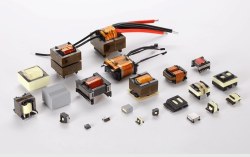
AI server power supplies are entering an uncomfortable stage of the efficiency race. The large, obvious semiconductor losses are shrinking as GaN and SiC devices improve. What remains is harder to remove: heat created inside transformers and inductors, AC resistance in windings, leakage energy, parasitic capacitance, and small production variations that become costly at scale.
This is why magnetic components often decide whether a promising server PSU design merely works on the bench or reaches its efficiency, temperature, and production targets in a real data center.
The Final Percentage Is the Hardest One
Under the official 80 PLUS criteria, a 230V/277V redundant data-center PSU must reach 96% efficiency at 50% load for Titanium certification. The newer Ruby level raises the requirement to 96.5%, with 97% specified for certain higher-voltage AC/DC input classes.
At these levels, the loss budget is extremely small. A magnetic component that runs only a few watts hotter than expected can erase the benefit gained from a more advanced switching device. The design question is therefore not simply “Which core or winding is smallest?” It is “Which magnetic structure produces the lowest total system loss while remaining repeatable in production?”
Higher Switching Frequency Solves One Problem and Creates Three More
Increasing switching frequency reduces volt-seconds per cycle and allows a smaller core cross-section. That is attractive in compact 1U and modular server power supplies. The TI PMP23146 reference design, for example, demonstrates a planar transformer operating at 400kHz in a server auxiliary supply.
But frequency cannot be increased in isolation. Core loss rises with frequency and flux swing. Skin and proximity effects increase the effective resistance of foil, flat wire, litz wire, and PCB windings. Parasitic capacitance can increase common-mode noise, while poor winding geometry can create excessive leakage inductance and voltage stress. A smaller transformer is not automatically a more efficient transformer.
Four Magnetic Decisions That Control Real PSU Performance
1. Core material must match the real waveform
Typical datasheet curves are useful for comparison, but server PSU magnetics operate with square, quasi-square, or resonant waveforms rather than ideal laboratory sine waves. Ferrite, nanocrystalline alloy, and metal-powder materials respond differently to frequency, temperature, DC bias, and flux swing. Final selection should be checked under the converter’s actual electrical conditions.
2. The winding is an AC structure
At high frequency, DC resistance tells only part of the story. Conductor thickness, strand diameter, layer arrangement, interleaving, and proximity to adjacent windings can change AC resistance dramatically. Adding copper without examining current distribution may increase cost and capacitance without solving the hotspot.
3. Leakage and capacitance must be designed together
Closer coupling can reduce leakage inductance, but it often increases interwinding capacitance. Greater spacing can improve insulation margin while increasing leakage energy and volume. In LLC and dual-active-bridge converters, these parameters also affect gain, soft switching, current sharing, and energy transfer. They are controlled design variables—not incidental defects.
4. Thermal validation must look inside
A reasonable surface temperature does not guarantee a safe winding hotspot. Potting material, clamps, busbars, and cold plates change the heat path, and dense windings can trap heat internally. Embedded thermocouples, representative prototypes, and sectioned thermal inspection provide more useful evidence than an exterior reading alone.
Production Consistency Is Part of Efficiency
A prototype can be tuned very precisely. A production line must reproduce that result across core batches, air gaps, winding tension, copper thickness, insulation placement, assembly pressure, and thousands of units. Small shifts in magnetizing inductance, resonant inductance, or leakage inductance can move the converter away from its optimized operating region.
That makes process windows, traceability, and electrical testing part of the magnetic design. Automated winding and PCB-based planar transformers can improve repeatability, but only when the stack-up, tolerances, and thermal path have been engineered for manufacturing from the beginning.
A Better Specification for Server PSU Magnetics
When requesting a transformer or inductor for a high-efficiency server power project, the specification should include more than power and inductance. It should define the operating waveform, switching frequency range, flux swing, ambient and hotspot limits, insulation system, target leakage or resonant inductance, allowable capacitance, cooling method, and production tolerance.
TrafoPSU develops custom high-frequency transformers, planar transformers, resonant inductors, and common-mode chokes for power-conversion systems from 50W to multi-kilowatt levels. Its engineering approach connects material selection, AC winding analysis, topology-specific parameter control, EMI behavior, thermal verification, and manufacturing repeatability.
For AI server power supplies, magnetics are no longer passive parts selected after the topology is finished. They are one of the main systems that determine how much power density, efficiency, and reliability the final platform can actually deliver.
FAQ
Why can magnetics become the main efficiency limit?
As semiconductor switching losses fall, core loss, AC copper loss, leakage energy, parasitic effects, and internal thermal rise make up a larger share of the remaining loss budget.
Why are planar transformers useful in server power supplies?
Their low profile, repeatable PCB or foil windings, and predictable geometry suit compact high-frequency designs. They still require careful stack-up, shielding, insulation, and thermal optimization.
Should designers always choose the highest switching frequency?
No. Higher frequency can reduce magnetic size, but it also increases core loss, AC winding resistance, EMI difficulty, and thermal stress. The correct target is the best system-level trade-off.