

A product marked “12μH, 75A” looks like it gives you the two numbers you need. If your converter calls for that inductance and current, the next step might seem obvious: check the price and order samples.
It is a useful starting point, but there are still questions to answer.
How was the inductance measured? What does the current figure represent? How much heat can the part handle in your enclosure? And will its terminals work with the board you are building?
When selecting a custom high current inductor, getting those details early makes the sample review much more useful.
Start with what your circuit needs
Before comparing products, describe the current flowing through the inductor.
Include the expected continuous current, ripple and peak conditions. Share the switching frequency and explain whether the load remains fairly steady or changes during normal operation.
A simple waveform sketch can help the supplier understand the requirement. It is especially useful when a single figure could mean average current, peak current or a short overload condition.
If your calculations are still developing, mark the assumptions. The supplier can discuss an open question with you, but it is harder to spot a number that looks final and is actually provisional.
Ask what the current rating means
Current ratings need definitions.
Saturation current relates to a specified drop in inductance as current increases. A thermal current rating relates to a stated temperature rise under particular test conditions. Coilcraft explains this distinction in its application note on current and temperature ratings.
For a buyer, the practical step is to request the criteria behind the published number.
What reduction in inductance defines the saturation current? What temperature rise is used for the thermal rating? What ambient temperature, board arrangement and cooling conditions apply?
Those answers help your engineer assess the proposed part. They also make comparisons between suppliers more meaningful.
Look beyond the nominal inductance
The inductance value in a product title is a reference value. Your circuit needs acceptable behavior while the component is carrying its operating current.
Ask for the inductance tolerance and the conditions used to measure it. Request inductance versus DC bias information where available, and discuss the minimum inductance your design requires under load.
The engineer responsible for the converter should review this information before the purchase decision is settled.
A component can appear to match the nominal requirement while behaving differently at the current your application actually uses. Checking this early gives you a better basis for choosing samples.
Use the TrafoPSU product as a specific starting point
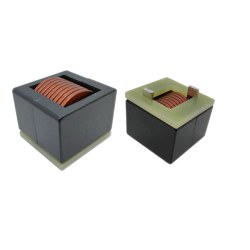
The TrafoPSU custom high current inductor 12μH–75A is listed as a through-hole product. Its page also discusses a broader high current inductor series and invites customers to provide electrical and dimensional requirements for customization.
That gives you a practical way to begin an enquiry.
Share your operating conditions and ask which configuration the supplier proposes. Request the electrical specification and mechanical drawing for that version, along with the available performance data.
Keep the individual product separate from the wider series description. A range of current ratings or construction options on a webpage does not mean every option applies to the part being quoted.
Put the thermal conditions in the brief
The enclosure is part of the application.
Tell the supplier about the expected ambient temperature, available airflow and nearby heat sources. Explain whether the inductor will operate in an open assembly or inside a compact housing.
Ask about winding resistance, the temperature at which it is specified, and the thermal data available for the proposed configuration. Resistance is useful information, but it does not establish the final operating temperature on its own.
Your team still needs to evaluate the component in a representative setup. Sharing the cooling conditions early makes the supplier’s proposal easier to assess.
Check how the part will be assembled
Through-hole mounting involves more than matching a body outline.
Review terminal spacing, hole requirements, maximum height, orientation and any assembly support requirements. Ask your manufacturing team whether the proposed arrangement suits its process.
A product photograph can show the general construction, but a dimensioned drawing is needed for footprint and clearance checks.
If the enclosure design requires a 3D model, request it during the enquiry. Finding a mechanical conflict before the board is released leaves you with more options than discovering it when samples arrive.
Make the sample review answer clear questions
Before ordering samples, decide what the tests need to establish.
Identify each sample and keep its drawing revision with the test record. Check dimensions and connections, then evaluate the electrical and thermal behavior under representative operating conditions.
When sending feedback, include the test setup, operating point and measured result. Mention any changes from the original brief.
Selecting a custom high current inductor is easier when the requirements, proposed construction and test results all refer to the same version. The headline rating helps you find a candidate. The supporting specification and sample results help you decide whether to use it.