

Battery cyclers are often purchased with a “bigger gives us more flexibility” mindset. A 5 A or 10 A channel certainly covers more peak-current cases than a 100 mA channel. It does not automatically make it a better instrument for a coin cell spending most of the test at a few milliamps.
For Neware BTS4000 projects, I would start with the current profile of the cell rather than the largest number on the tester.
Neware’s battery tester range includes BTS4000 configurations for coin cells, material research and higher-current cells. Some configurations use several current ranges so the instrument can measure low current without giving up the ability to run larger steps.
Pull three old test files from the lab
Instead of designing the purchase around hypothetical future work, take three protocols the lab already runs. Write down the lowest current, normal charge/discharge current, largest pulse, pulse width and required recording interval.
That exercise quickly shows whether one channel specification can cover everything comfortably.
Long-cycle coulombic-efficiency work is particularly sensitive to small measurement errors. A tester spending most of its time near the bottom of an oversized range may be less useful than a lower-current configuration, even though its maximum rating looks more impressive.
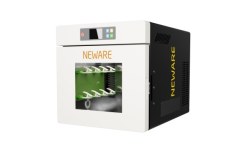
Neware also supplies environmental chambers and integrated battery-test systems. That matters because electrical precision and temperature consistency have to live together.
Fast pulses are a different job
HPPC, DCIR and transient work need adequate response time and data recording. A channel chosen for slow capacity cycling should not be assumed to be equally suitable for short pulses.
Check the full signal path as well. Long leads, tired fixtures and inconsistent contact pressure can add resistance that the cycler cannot distinguish from the cell.
One simple qualification test is to run the same reference cell on several channels under the same chamber conditions. Compare capacity, DCIR and temperature. Channel-to-channel consistency is more informative than staring at one accuracy figure in a brochure.
Keep the reference-cell identification, fixture setup and test-file version with the results. This gives the next technician enough context to repeat the comparison without guessing how the first run was arranged.
More channels only help when the data can be trusted. I would rather have a mixed rack of well-matched channel ranges than one oversized specification used for every experiment.