

Now the VMFinance channel is at MAX - only reviews and nothing superfluous.
The metallurgical sector continues to feel pressure: high Central Bank rates are cooling domestic demand, and global steel prices are in no hurry to rise. Against this background, NLMK, one of the largest steelmakers, is showing predictably weak financial results, as is the entire sector as a whole, but is laying a strong foundation for the future.
But the drop in profits hides a "financial cushion" of titanic proportions and a bet on the future. We're figuring out what's going on with the company and where to look for growth points.
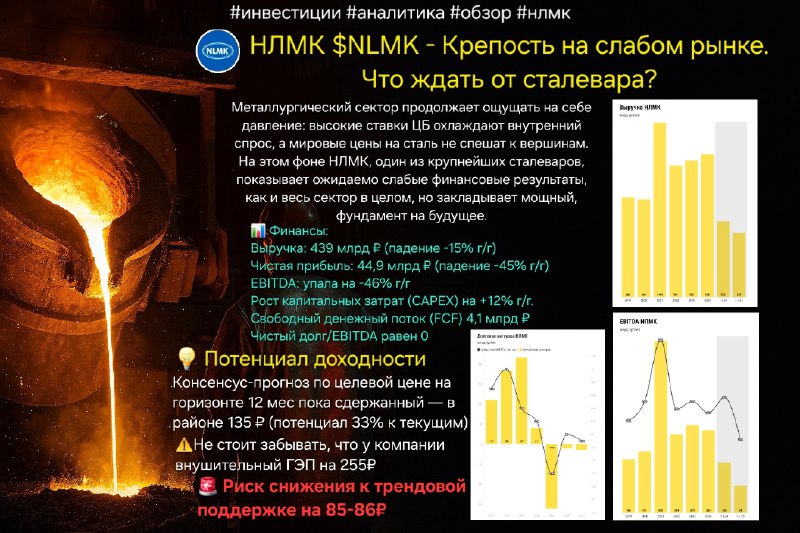
Finance:
The latest available IFRS financial statements reflect a market-wide negative.
The company publishes a minimum of information without press releases, which makes analysis difficult, but the numbers speak for themselves.:
Revenue: 439 billion (decrease -15% YoY)
Net profit: 44.9 billion (decrease -45% YoY)
EBITDA: decreased by -46% YoY
The main reason is the decline in global steel prices, weak domestic demand and overproduction.
The most painful indicator is the Free Cash Flow (FCF). It has practically reset to zero, amounting to only 4.1 billion (a 17-fold drop).
This happened for two reasons:
1. A sharp decline in operating profit (EBITDA).
2. Growth of capital expenditures (CAPEX) by 12% YoY
And now the MAIN thing you need to know about NLMK:
Like Severstal, the company's net debt is close to ZERO.
The refusal to pay dividends allowed the company to finance a large-scale investment program without getting into expensive loans during the peak rate of the Central Bank.
And what about dividends?
NLMK's dividend policy is linked to FCF and debt. According to the formula, if the Net debt/EBITDA is below 1x (and the company has 0), at least 100% FCF is allocated for payments.
The problem is obvious: free cash flow (FCF) is now almost zero.
Conclusion: We should not expect dividends by the end of 2025. Like other players in the sector, NLMK is reinvesting all available cash into modernization. This is a strategically sure step for future growth, but a disappointment for investors focused on fast cash flow.
Growth triggers: taxes and the Central Bank rate
The company has two key drivers for recovery:
State support (in brief): The Ministry of Finance has already developed a draft resolution on deferral of excise taxes on liquid steel and mineral extraction tax on iron ore. This is not a tax repeal, but a measure that will support the financial stability and cash flow of the industry during the most difficult period.
Mitigation of PREP (long-term): This is the main driver for the entire sector. The current harsh policy of the Central Bank has hit the construction sector and industry, which are key consumers of steel. Further mitigation of PREP and the expected cycle

There are no comments yet.