

In April this year, Turkey's imports of billets and blooms totaled 402,539 metric tons, down 27.3 percent from March and up 49.9 percent year-on-year, according to preliminary data provided by the Turkish Statistical Institute (TUIK). Meanwhile, the income generated from these imports amounted to US$199.58 million, down 25.9 percent from the previous month and up 45.8 percent year-on-year.
Between January and April, imports of Turkish billets and blooms totaled 1,680,238 tons, up 53.9 percent, and the value of these imports increased by 47.4 percent to 825.29 million US dollars year on year.
Imports of billets and blooms to Turkey - for the last 12 months
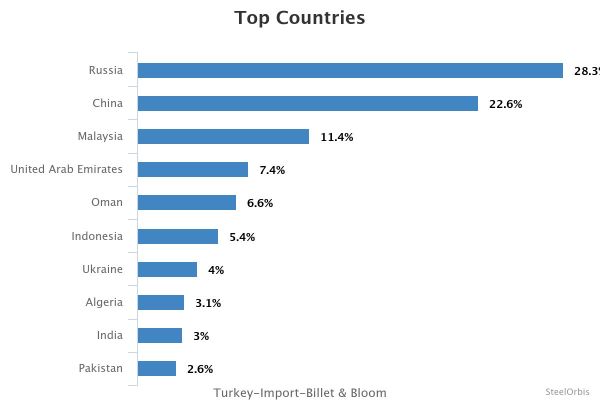
During the period, the largest source of imports of billets and blooms to Turkey was Russia, which supplied 474,046 tons, which is 128.7% more than last year. Russia is followed by China with 378,552 tons, down 269.7 percent, and Malaysia with 190,615 tons, down 47.7 percent.
In Turkey's imports of harvested and flowering products, Malaysia, which ranked first last year, fell to third place this year with a 47.7 percent year-on-year decline, while Russia rose in first place with an increase of 128.7 percent. 474,046 tons. China also moved up to second place, up 269.7 percent year on year. Russia, China, Malaysia, Oman, Ukraine and Pakistan were in the top ten in both periods, while the UAE, Indonesia, Algeria and India made this year's list.
In terms of total tonnage, imports increased 53.9 percent year-on-year to 1.68 million tonnes between January and April, indicating that Turkey's demand for processed foods remains high and that some buyers continue to turn to imports blanks, and not to the import of blanks. scrap. However, a 27.3% month-on-month decline in April imports to 402,539 tonnes suggests purchasing activity has become more selective despite the overall upward trend. Market reports show that high scrap prices prompted some buyers to restock billets, while weak rebar sales continued to limit demand at times; в последнее время торговля на турецком рынке заготовок замедлилась, причем среди доступных вариантов импорта выделяются изделия российского и китайского происхождения.
Топ-10 источников импорта заготовок и блюмов в Турцию в период с января по апрель:
| Country | Volume (t) |




There are no comments yet.