

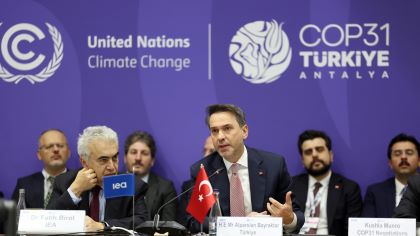
Turkey expects to need about $300 billion in investment by 2040 to shift to a low-carbon energy system. Energy and Natural Resources Minister Alparslan Bayraktar announced the estimate at an International Energy Agency ministerial meeting in Antalya, held alongside the UN climate conference COP31.
Under the National Energy 2040 strategy, Turkey aims to increase its installed electricity generation capacity from about 128 GW today to 281 GW. Solar and wind power are expected to account for 175 GW of that total. The target is to raise renewables’ share of installed capacity from 63% to 77%.
The government also plans to bring 10 GW of nuclear capacity online, develop 40 GWh of battery storage and expand cross-border electricity interconnection capacity to 15 GW. The investments are intended to help integrate more renewable power, strengthen grid resilience and support regional cooperation.
Bayraktar identified electrification as a central part of the strategy. Turkey aims to meet rising energy demand with electricity while reducing its reliance on oil and natural gas. He said energy supply security had increasingly become a national security issue amid economic and geopolitical challenges, while countries also needed to cut emissions to meet their climate commitments.
Turkey’s National Energy Efficiency Action Plan, announced two years ago, envisages $20 billion in investment between 2024 and 2035. Bayraktar said energy-efficiency measures combined with electrification could generate cumulative savings of about $240 billion by 2040.
Attracting the required funding will depend on international partnerships, new technologies and predictable conditions for investors, the minister said. Turkey also intends to strengthen its domestic energy infrastructure and contribute to reliable energy supplies in the region and internationally.




There are no comments yet.