

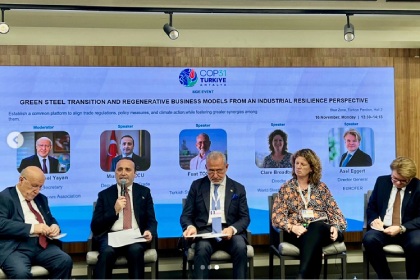
Fuat Tosyalı, chairman of Tosyalı Holding and the Turkish Steel Producers’ Association (TÇÜD), called for closer coordination of emissions measurement, decarbonization finance and trade policy to support the steel industry’s shift to low-carbon production. He made the remarks at a COP31 panel in Antalya.
Climate measures should rely on verified product-level emissions data and recognize carbon costs already paid by producers in their home countries, Tosyalı said. This would help prevent carbon charges from being imposed twice. He argued that carbon revenues should go toward clean energy, energy efficiency, direct reduced iron (DRI) and hydrogen. Climate policy should be judged by actual emissions reductions, not compliance with regulations alone.
Tosyalı also warned against trade barriers that could restrict market access for low-carbon steel. In his view, climate and trade policies should encourage the use of products with verified lower emissions rather than create additional obstacles.
He pointed to the share of electric arc furnaces (EAFs): they accounted for 72.2% of Turkey’s crude steel production in 2025, compared with 45.8% in the EU. Citing a 2022 study by the European Commission’s Joint Research Centre, Tosyalı said emissions from steel production in the EU were 31% higher than in Turkey, while China’s were almost twice as high.
Access to raw materials is another concern for Turkey. The country imported about 18.7 million tonnes of steel scrap in 2025. Rising demand for high-quality scrap and possible export restrictions could add supply risks for producers that rely on it. Tosyalı called for better domestic scrap collection, sorting, traceability and quality, as well as greater access to alternatives including DRI, hot-briquetted iron (HBI) and cold DRI.
Discussing Tosyalı Holding’s investments, he said the company’s two DRI plants in Algeria had reached record production levels. Hot-charging technology offers energy savings of up to 20% compared with conventional cold charging. The second Algerian plant is designed to use hydrogen, while the company’s cold DRI investment in Libya is part of its broader raw-material supply strategy.
Tosyalı urged Turkey and the EU to deepen industrial cooperation, saying that combining Turkey’s low-carbon steelmaking capacity with Europe’s industrial and technological expertise could strengthen competitiveness on both sides. He also called on the EU to give Turkey preferential treatment as a green steel partner and increase the relevant steel import quotas.




There are no comments yet.