

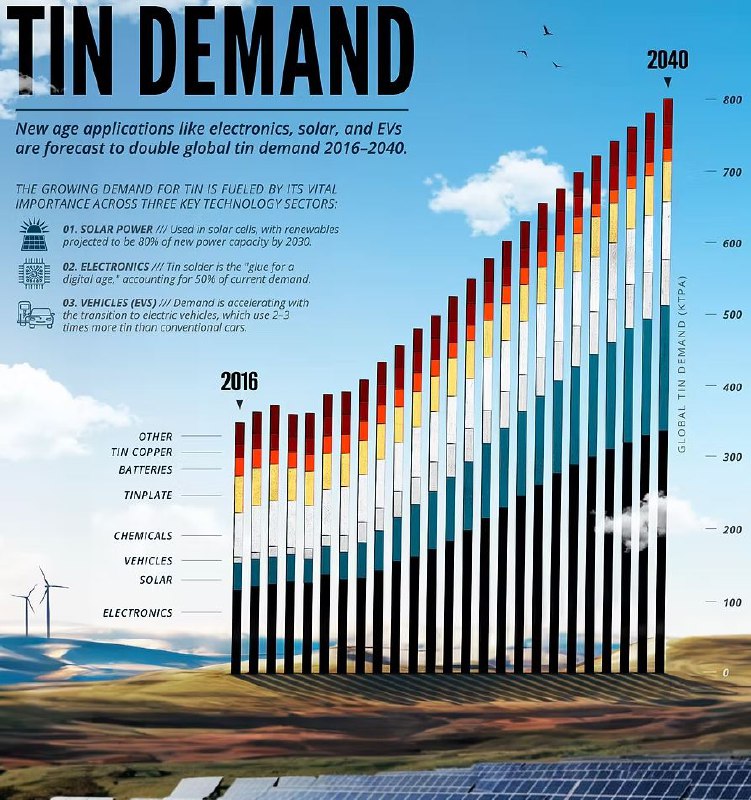
Tin's most important role is to serve as the "glue for the digital age." As the main component of electronic solder, it is indispensable for bonding printed circuit boards in everything from smartphones to data centers, providing 50% of its current demand.
This demand will grow. According to the International Tin Manufacturers Association (ITA, 2024), the semiconductor market is projected to grow at an average annual rate (CAGR) of 7% until 2030, which will ensure a steady and growing demand for tin for manufacturing equipment in our increasingly interconnected world.
Solar energy: The expansion of solar energy has a direct impact on the demand for tin. Although solar energy accounted for 4.5% of global energy production in 2022, its growth is rapid. Market forecasts show that by 2030, renewable energy sources will provide 80% of all new installed generating capacity. Large-scale construction of solar infrastructure will require a significant and ever-growing supply of tin.
Electric vehicles (EM): The transition to electromobility leads to a dramatic change in tin consumption. An electric car consumes 2-3 times more tin than a conventional car with an internal combustion engine⁴. This figure, in particular, does not take into account the additional amount of tin needed to develop the charging infrastructure. According to forecasts, by 2030, the share of electric vehicles in total car sales will range from 30% to 60%, so the automotive sector will become the main driver of tin demand.
Looking to the future, it can be noted that new technologies such as sodium-ion batteries, which can potentially use tin in their anodes, represent another important source of future demand.




There are no comments yet.