

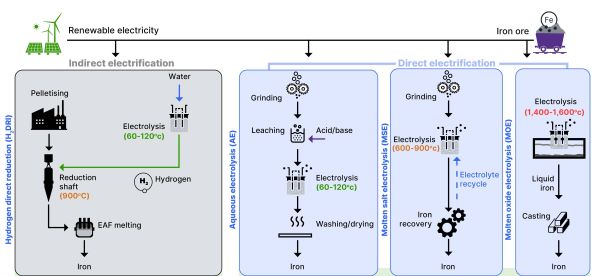
According to a new information note from the Institute for Energy Economics and Financial Analysis (IEEFA), direct electrolysis of iron may occupy a niche in small-scale production of environmentally friendly iron, especially in regions with large amounts of renewable electricity and reserves of low-grade iron ore.
This technology can provide advantages over other low-carbon cast iron production methods by using lower-quality ores with limited or no added processing and requiring fewer ancillary infrastructure. However, according to IEEFA, scalability and access to low-cost, clean electricity remain key challenges.
In direct electrolysis, ores with a total iron content can be used. 35%.
The IEEFA identified three main production methods: low-temperature electrolysis, molten salt electrolysis, and molten oxide electrolysis. When using environmentally friendly electricity, these processes can lead to the production of iron with almost zero emissions.
In some electrochemical processes, magnetite containing as little as 35% iron can be used, eliminating the need for coal, natural gas, or hydrogen as reducing agents. They can also eliminate such traditional steps as coking, sintering and granulating.
According to the IEEFA, these characteristics can make direct electrolysis suitable for small-scale cast iron production projects in renewable energy-rich countries. regions.
Commercial scalability remains challenging задачей
Despite its potential, IEEFA said that industrial-scale production has yet to be demonstrated, and current production is limited to tons per day at best. Electricity also remains a major cost driver, making access to abundant and inexpensive clean energy critical.
Companies developing electrochemical cast iron production technologies include Boston Metal, Electra, and Volteron, while Fortescue and Element Zero are developing their own approaches.
IEEFA concluded that although direct electrolysis of iron is at an early stage, its ability to use lower-quality ore and potentially flexibly work with renewable energy sources can play an important role in the future production of environmentally friendly cast iron.


There are no comments yet.