

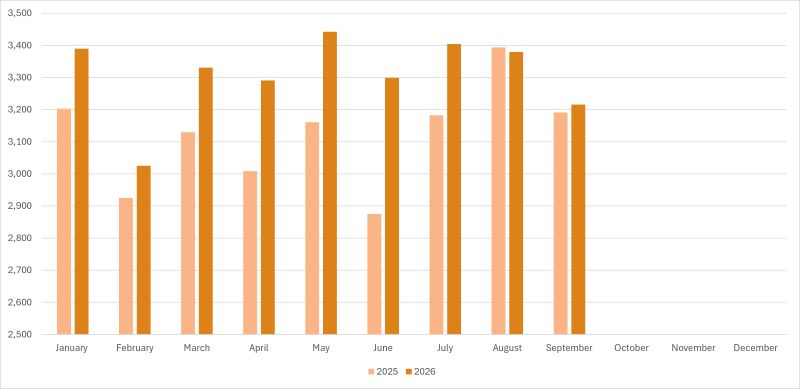
Turkey produced 29.77 million metric tons of crude steel in January–September 2026, up 6.1% year on year. September output rose 0.8% to 3.21 million metric tons, the Turkish Steel Producers’ Association (TCUD) said.
Finished steel production increased 2.7% over the nine-month period to 32.72 million metric tons, while consumption grew 2.2% to 29.5 million metric tons. Billet production was unchanged at 17.81 million metric tons, while slab output rose 16.6% to 11.96 million metric tons.
Steel exports in January–September reached 11.59 million metric tons, up 1.9%, and were valued at $7.9 billion, an increase of 2.6%. September exports fell 6.4% year on year to 1.27 million metric tons, although their value rose 0.8% to $902.55 million. Exports of semi-finished products jumped 64.8% over the nine months to 749,284 metric tons.
Imports fell 5.7% to 13.35 million metric tons in January–September, with their value down 5.3% to $9.36 billion. September imports declined 22.3% to 1.17 million metric tons, while their value dropped 12.8% to $908.39 million. The export-to-import ratio increased to 84.46%, from 77.92% a year earlier.
According to TCUD, imports accounted for 44.1% of steel product consumption in the first nine months of the year and 58.5% of flat steel consumption. The association called for a shift toward higher value-added exports, faster investment in low-carbon steelmaking and measures to limit pressure on the domestic market from dumped and subsidized imports.




There are no comments yet.