

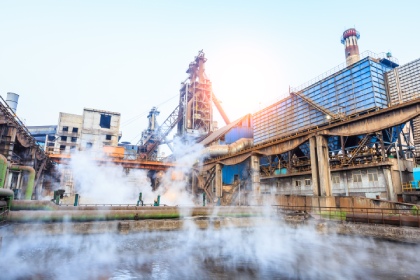
Participants at a Japan Iron and Steel Federation (JISF) event held during the 31st UN Climate Change Conference on November 17 said investment in low-carbon steel production requires sustained demand and costs to be shared across the value chain, including by end buyers.
Hirofumi Funakoshi, vice chair of JISF’s Environment and Energy Committee and executive vice president of Nippon Steel, said developing and deploying new technologies, including hydrogen-based steelmaking, takes time and substantial investment. Emissions must continue to fall through available methods while those solutions scale up. Supply-side efforts alone are not enough, he said: buyers need to recognize the environmental benefits of products to give investors greater certainty.
Catherine McFarlane of Mission Possible Partnership said the organization tracks more than 1,000 deep-decarbonization projects in energy-intensive industries, representing an investment opportunity of about $4.8 trillion. Thirty-six projects reached final investment decisions this year, but only one was in steel, in China. Construction and automotive account for about 65% of steel use. Some projects need 10- to 12-year offtake agreements to secure financing, and demand from a single buyer is often insufficient.
Mission Possible Partnership estimates that costs begin to fall and investor confidence rises when low-carbon products reach 5–10% of their markets. Demand-side support for low-carbon steel would need to increase 18-fold to reach a 5% market share. If only Climate Club members take part, lead sectors such as construction and automotive would need a 40% green-steel mandate. With all major steel-producing economies participating, 20% would be enough. McFarlane said a lower starting level was possible, but the schedule for increasing it should be announced in advance.
In Japan, demand for GX Steel remains only slightly above 100,000 tonnes despite support from public procurement and private buyers. Hitoshi Dohnomae, chair of JISF’s International Environmental Strategy Committee, said this is about 0.1% of sales by Japanese blast-furnace steelmakers. Capacity could reach 3 million tonnes by 2030, but decarbonization may stall without stronger demand. Dohnomae cited limited supplies of scrap of the required quality, clean energy and hydrogen, as well as high costs, as obstacles.
Toshitake Tanuma of WWF Japan proposed lowering production costs through cheaper clean electricity and supplies of green-hydrogen-based direct-reduced iron, including from Australia. In his assessment, shifting 40–50% of public procurement to green steel could create enough demand to absorb 3 million tonnes of annual production. Tax incentives for companies buying the material could provide another boost.
Ryuzo Sugimoto of Japan’s Ministry of the Environment said the government is working to create initial demand through public procurement, encourage private buyers in construction and automotive, and assess the environmental value of products. Dohnomae added that customers remain reluctant to pay a premium even when the increase in the final price is small, while EU carbon prices remain below the industry’s emissions-reduction costs. Clear, long-term demand signals are needed for investment decisions, he said.
Ovais Sarmad of the GHG Protocol said the organization is working with ISO on harmonized standards, with updates to Scope 2 and Scope 3 rules expected in the second quarter of 2027. Sedigas Secretary General Naiara Ortiz de Mendíbil Romo said steel needs biomethane and renewable hydrogen alongside electrification. Closing the discussion, moderator Hiroyuki Tezuka of JFE Steel said transition costs must be shared across the value chain, including by end consumers, and the value of emissions reductions must be made visible.
There are no comments yet.