

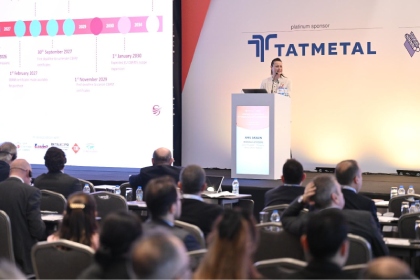
Speaking at the Eurometal Steel Day and YISAD Flat Steel Conference, organized in collaboration with SteelOrbis at the Istanbul Marriott Asia Hotel on Tuesday, March 24, Anıl Akalin, President of Environmental Markets, Country President of Turkey and GCC at British consultancy Redshaw Advisors, said that the European Carbon Border Mechanism (CBAM) will significantly increase costs and change trade flows for European-focused exporters market.
Akalin noted that the final phase of CBAM began on January 1, 2026, marking the transition to full financial implementation of the mechanism.
Gradual implementation until 2034
According to Akalin, CBAM certificates will become available in 2026, with the first certificate deadline set for September. 30, 2027.
The mechanism will be gradually introduced until 2034, when 100 percent of embedded emissions will be covered, in parallel with the complete phase-out of free allowances under the EU Emissions Trading Scheme. Failure to comply with CBAM requirements will result in fines of €100 per ton, and failure to obtain declarant status may result in fines of up to €500 per ton.
Opportunities for expansion across sectors
CBAM is expected to expand the scope of its activities over time. By 2028, it is expected to include industries such as white goods, automobiles, metallurgy and engineering, with downstream industries such as plastics and chemicals likely to follow in later stages. Akalin emphasized that this mechanism will become increasingly complex, and the entire cost burden will ultimately be borne by producers.
Carbon prices are expected to rise in the long term
Akalin emphasized that prices for CBAM certificates are not directly equal to the prices of EU ETS allowances, but follow from similar market ones mechanisms. EU carbon prices have shown significant volatility over the past decade and current lower levels should not be interpreted as a long-term trend.
Analysts expect carbon prices to rise over time, potentially reaching €200 as the market moves into the 2030s. By 2050, the reduction in the supply of emissions allowances is expected to support persistently high carbon prices.
Significant impact on the value of Turkish exports




There are no comments yet.