

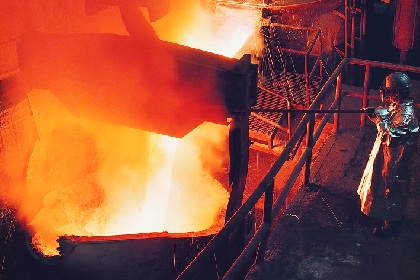
German steel production rose 7.5 percent year-on-year in March to 3.35 million tons, according to information provided by the German Steel Federation Wirtschaftsvereinigung Stahl (WV Stahl). In January-March, output increased by nine percent year-on-year to 9.26 million tons
The output of cast iron and hot-rolled products also increased
In this month, the output of pig iron in Germany amounted to 2.02 million tons, an increase of 6.7 percent, while in January-March it increased by 10.4 percent to 5.87 million tons, in both cases year-on-year.
In March, the production of hot-rolled steel in the country increased by 3.5 percent to 2.89 million tons, and in the first three months of this year it increased by 4.9 percent to 8.01 million tons compared to the same periods of the previous year.
The increase in production does not reflect a real recovery
Despite the growth, W. V. Stahl cautioned that production growth does not indicate a genuine recovery.
According to CEO Kerstin Maria Rieppel, the current production level, equivalent to about 37 million tons per year, remains below the threshold of 40 million tons required for sustainable capacity utilization.
German steel production has already fallen to 34.1 million tons in 2025, the lowest level since the global financial crisis.
Demand weakness remains structural
Weak demand remains the main problem. Since 2017, German steel consumption has decreased by about 30 percent, or 12 million tons, with key industries such as automotive and mechanical engineering still lagging behind. The recent improvement in supply conditions is largely due to restocking rather than a recovery in real demand.
Germany's position in global steel consumption has dropped to eighth place, reflecting a broader decline in industrial demand. At the same time, growing imports are increasing pressure on domestic producers.
Import pressure and global overcapacity
Global overcapacity, which the OECD predicts will exceed 700 million tons by 2027, continues to distort trade flows and increase competition. In this context, the Federation welcomed the new EU trade protection measures needed



There are no comments yet.