

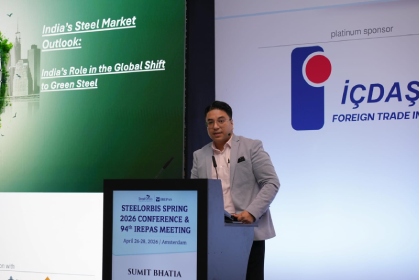
Mr. Bhatia noted that the availability of scrap worldwide is declining as exports continue to be concentrated in a limited number of regions, while major suppliers such as the United States, the EU and Japan are increasingly prioritizing domestic consumption. More than 60 countries have already imposed restrictions on scrap metal exports, and availability is expected to decrease further by 2030.
An increase in demand will lead to a change in the demand for raw materials
An ARS Steels representative said global steel demand is projected to grow from about 1.8 billion tons to 2.6-2.7 billion tons by 2070, with growth led by India, Southeast Asia and Africa, and China's contribution stabilizing due to the structural weakness of its real estate sector.
He added that at the same time, the production structure is expected to change significantly. The share of blast furnace production, which currently dominates, will decrease, while electric arc and induction furnace production is projected to grow to about half of total production by 2070, driven by decarbonization policies and shortages of raw materials.
Carbon policy is changing the dynamics of trade
Mr. Bhatia stressed that steel trade is increasingly dependent on carbon emissions regulation. The EU emissions trading system imposes direct carbon costs on producers, while CBAM spreads these costs to imports, effectively changing competitiveness.
He noted that high-carbon steel is losing market access, while low-carbon steel is gaining a price advantage, marking a shift from cost-based trading dynamics to carbon-based trading dynamics.
Steel growth in India accelerates
India is expected to remain a key growth engine, Mr. Bhatia said, adding that its crude steel production is projected to reach 165 million tons in fiscal year 2026-27 and grow to 223 million tons by 2030-31, representing strong growth.
This growth is driving demand growth.




There are no comments yet.