

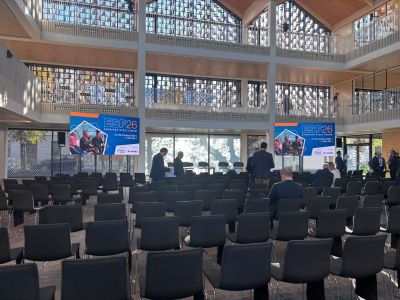
Participants at the European Steel Forum in Udine identified the conditions needed for the industry’s shift to lower-carbon production: affordable clean energy, suitable raw materials and rules that make investment viable. The forum, organized by the Association for Iron & Steel Technology (AIST) in cooperation with Danieli, is being held on October 27–28.
The opening included Giacomo Mareschi Danieli, CEO of Danieli & C.; Rolando Paolone, CEO and CTO of Danieli Group; and José Noldin, chair of AIST’s European Member Chapter and CEO of GravitHy. The first day’s discussions covered production modernization, energy, trade and raw materials.
Investment in new technology and the cost of transition
AIST Executive Director Ron Ashburn described the market as undergoing a realignment. He said the industry is being shaped by changes in globalization, as supply security becomes as important as efficiency; excess capacity, which is widening trade imbalances; and opportunities linked to decarbonization, artificial intelligence and electrification.
At a panel on the transition of the European steel industry to carbon neutrality, participants outlined modernization and emissions-reduction projects. Andrea Bianchi, CTO of Arvedi Group, presented the company’s ESP production model, which can produce 2.8 million metric tons of hot-rolled coil a year. The discussion also covered voestalpine’s Hy4Smelt demonstration project, HYBRIT technology for hydrogen-based direct reduced iron production, and transformation programs at Stahl-Holding-Saar and Salzgitter Flachstahl.
Industry representatives reaffirmed their commitment to investment, although achieving carbon neutrality may take longer than expected. Martin Pei, senior adviser at SSAB, said the company would continue replacing blast furnaces with electric arc furnaces and expand the use of sustainable inputs. Bianchi said carbon capture still appeared impractical, but the company would not abandon its goals.
Sebastian Börner, technical project manager for Power4Steel, stressed that the transition requires both new facilities and the modernization of existing plants. He said the volume of “green” steel production would depend on how much clean energy could be made available.
Decarbonization must not lead to deindustrialization
Antonio Marcegaglia, head of Marcegaglia, warned that cutting emissions must go hand in hand with maintaining production in Europe. He called for technologically achievable targets and said the EU Emissions Trading System (ETS) should focus on its regulatory compliance role, without allowing financial and speculative considerations to take precedence.
Marcegaglia welcomed recent trade safeguard measures but called for them to be implemented in a coordinated and pragmatic way. In his view, an excessively isolated European market could encourage steel imports in finished goods and components while restricting exports by European companies. He said the Carbon Border Adjustment Mechanism (CBAM) should offset the additional decarbonization costs borne by European producers, rather than become a protectionist tool. Excessive steel price increases, in turn, could prompt downstream industries to buy imported components that fall outside the mechanism.
Energy and raw materials are key to the transition
At a discussion on carbon-free energy sources, representatives of the steel, cement and lime sectors examined the links between energy-intensive industries. Gabriele Imparato of Unicalce said the steel industry accounts for about one-third of global lime production. Participants also noted that the energy transition requires energy to be affordable, sustainable and reliable at the same time.
Imparato said the main challenge was not technology itself, but creating clear conditions for regulation and investment. Gabriele Guastaferro of Danieli Green Metal added that available solutions must be adopted widely enough to become industry standards. Potential support measures discussed included industrial heat auctions planned under the EU Innovation Fund.
The day’s final discussion on raw materials and production geography covered trade in direct reduced iron and hot briquetted iron (DRI/HBI). Naota Furihata of Mitsui put global trade in the material at 12.4 million metric tons, compared with 79 million metric tons for scrap. According to the estimates presented, the market could remain relatively balanced through 2030; much will depend on high-quality scrap availability and demand from new steelmaking projects.
Thomas Brown of Binding Solutions estimated that pellet production could reach 190 million metric tons if all announced projects are completed. Thiago Campos of SMS group pointed to growing difficulties in sourcing high-grade iron ore and the need to develop technologies that can effectively process lower-grade material.
The first day’s overarching message was that European companies intend to invest in lower-carbon production, but the pace of transition will depend on energy costs and availability, raw material quality and project economics. Participants called for climate goals to be aligned with the conditions needed to sustain European production and competitiveness.



There are no comments yet.