

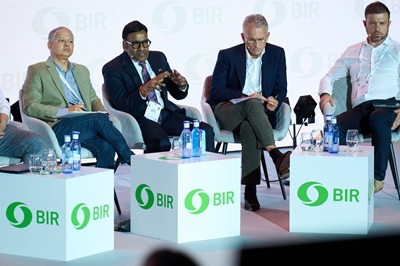
Africa is becoming more important to global scrap markets, but expanding electric arc furnace steelmaking will not necessarily lead to a proportional rise in imports. That was a key theme at the BIR World Recycling Convention & Exhibition, held in Malaga on October 25–27, 2026.
Availability of direct reduced iron (DRI), competition from Asian finished-steel suppliers and trade restrictions will all influence demand. Participants also warned that artificially low scrap prices could undermine collection and investment in recycling.
BIR ferrous metals division president Shane Mellor stressed that Africa is not a single market: some countries have established steel and recycling industries, while others lack essential infrastructure. According to worldsteel data reported by BIR, African steel demand is expected to grow by around 4.4% in 2026. Production on the continent reached 19 million tonnes in the first nine months of the year, almost 10% higher than a year earlier.
African steel production rose 10% year on year to 12.6 million tonnes in January–June, while global output fell 0.7% to 931.5 million tonnes, according to Rolf Willeke, statistical adviser to BIR’s ferrous metals division. Egypt remained Africa’s biggest producer, with output up 13.6% to 5.7 million tonnes. It was also the continent’s largest scrap importer, increasing purchases by 98.6% to 2.1 million tonnes.
Egypt has become particularly important to European suppliers. EU scrap shipments to the country rose 96% to 1.106 million tonnes in the first half of 2026. Extra-EU exports increased 4.5% to 8.52 million tonnes, while scrap consumption within the EU fell 3.2% to 38.138 million tonnes. All figures are compared with the same period in 2025.
Atilla Widnell, founder and managing director of Navigate Commodities, said flows to Egypt later slowed. In his assessment, rising imports of finished steel from China are putting pressure on local producers, while greater availability of DRI can replace some scrap in electric arc furnace charges. DRI-based plants in Algeria similarly limit the need for imported scrap. New EAF capacity, therefore, does not automatically mean higher scrap consumption.
Morocco presents a different picture: new EAF capacity has supported scrap purchases and reduced reliance on imported semis for rerolling. Widnell urged market participants to distinguish announced projects from operating plants and to account for construction timelines and gradual production ramp-ups.
Another risk is the possible restriction of European scrap shipments to non-OECD countries under the EU Waste Shipment Regulation. Widnell said restrictions affecting Egypt and Morocco could particularly hurt smaller operators in containerized scrap trade. The countries may then turn more often to the United States and the United Kingdom, although the outcome depends on the authorization process.
South Africa provided a case study in the effects of export restrictions. Donald MacKay, CEO of XA Global Trade Advisors, said the Price Preference System requires scrap to be offered to domestic buyers at a discount before it can be exported. Exports also face an additional 20% duty. The measures benefit local consumers, he said, but depress prices and incentives to collect scrap.
Quintin Starkey, president of the Metal Recyclers Association of South Africa, said coastal recyclers face high transport costs to reach consumers concentrated around Johannesburg. Employment in the sector has fallen from 15,000 to 9,000, he said, linking lower prices to companies exiting the market and reduced investment. Trade between African countries is also constrained by a severe lack of road and rail links, while river transport cannot be relied upon.
Sanjay Mehta, director of MTC Group and president of India’s Material Recycling Association, sees opportunities in developing local collection, sorting and processing. He divided Africa into four broad regions — north, west, east and south — each with distinct characteristics and at a different stage of development. A young population and major infrastructure gaps offer growth potential: investment in the sector could support steel demand and, over time, increase scrap availability.
Panel moderator Abhijeet Mahanta, director of Stelaris Resources, cited the shift of some African markets from exporters to importers. Nigerian scrap purchases, for example, rose 300% in a year, although volumes remain limited. Tom Bird, executive chairman of Enicor, warned of political instability, regulatory uncertainty and corruption.
“Trading is one thing, but putting hard dollars or euros into investment there is an entirely different matter. It takes careful preparation, understanding of local conditions and a realistic assessment of the political and commercial risks involved. If you decide to go into Africa, keep your eyes wide open,” Bird said.




There are no comments yet.