

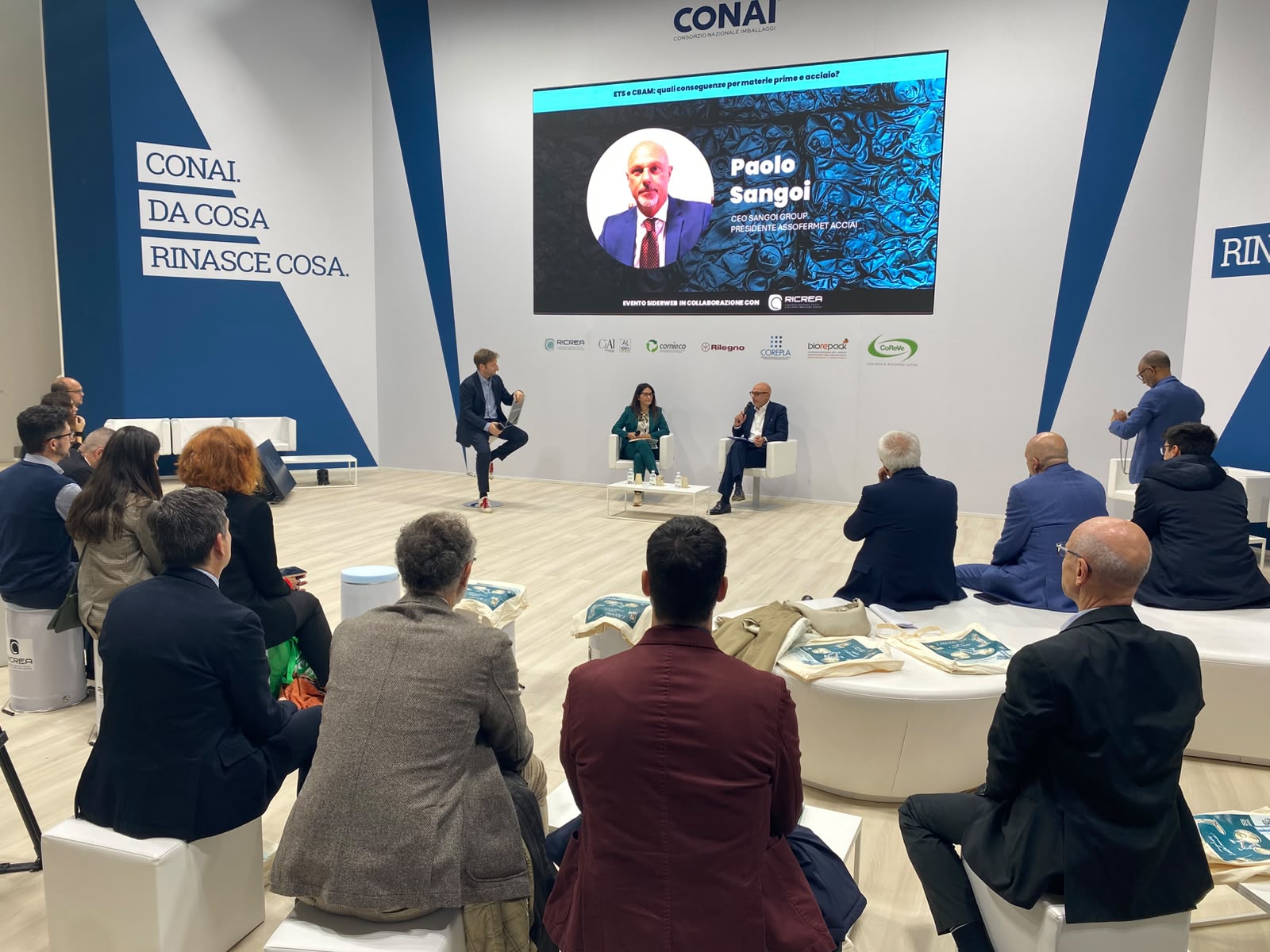
New EU climate and trade measures could support European steelmakers while raising costs for processors and industrial buyers. Their impact on raw materials, prices and competitiveness was discussed on November 5 at a conference organized by siderweb and RICREA, Italy’s consortium for the recycling of steel packaging, during Ecomondo 2026 in Rimini.
The discussion focused on the definitive phase of the Carbon Border Adjustment Mechanism (CBAM), which began on January 1, 2026, and the gradual phase-out of free allowances under the EU Emissions Trading System (EU ETS), set to continue until 2034. The mechanisms are intended to speed up industrial decarbonization and reduce the risk of production moving to countries with less stringent environmental rules.
The EU is also tightening protection of its domestic steel market. A new tariff-rate quota system will cut import quota volumes by about 47% compared with the previous safeguards, while the out-of-quota duty will rise from 25% to 50%. Importers will also have to verify the country where steel was melted and poured. The melt and pour requirement is intended to improve supply-chain traceability.
Stefano Ferrari, head of research at siderweb, said the import restrictions could ease pressure on European producers and support prices, margins and capacity utilization, provided demand remains strong enough. But any gains may be offset by high energy prices, rising carbon costs and the substantial investment needed to adopt low-emission technologies.
Higher steel costs could hit distributors, steel service centers and manufacturers that use steel as a raw material particularly hard. Paolo Sangoi, CEO of Sangoi Group and president of Assofermet Acciai, warned that distributors may have to pass the additional costs on to customers. At the same time, imported finished goods from third countries may not face equivalent requirements. Sangoi called on the EU to support industrial consumption and production, warning that rising costs could accelerate the relocation of manufacturing outside Europe.
The business case for investment in low-emission steelmaking will depend on whether buyers are willing to pay more for steel with a lower carbon footprint. Isabella Manfredi, chief sustainability officer at Feralpi Group and president of Sustainability Makers, said decarbonization efforts were continuing despite revisions to some EU requirements. Demand for sustainability data and supply-chain transparency is growing, she said, making reliable, verifiable emissions information increasingly important to producers.
Participants also highlighted scrap as a key raw material for electric arc furnaces, which are playing a growing role in decarbonization. RICREA president Domenico Rinaldini said Italy imports around 7–8 million tonnes of scrap each year to meet the needs of its steel industry. Maintaining domestic collection and expanding recycling are essential both to secure supplies and to meet climate targets. Rinaldini also pointed to expected changes in packaging management and extended producer responsibility systems under the EU Packaging and Packaging Waste Regulation (PPWR).
Conference participants said the outcome of EU climate and trade policies will depend not only on protecting domestic producers and cutting emissions, but also on access to competitively priced energy, investment in new technologies and sustained industrial demand. The challenge is to reduce emissions without undermining the competitiveness of steelmakers, distributors and downstream manufacturers.


There are no comments yet.