

In 2025, global steel industry emissions actually decreased slightly by 0.4 percent year-on-year. But this was due to lower production due to weak economic sentiment and falling demand, not due to the introduction of low-carbon technologies.
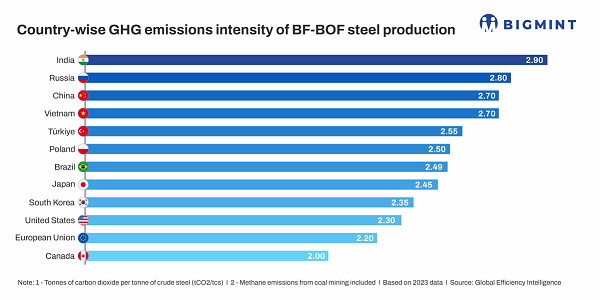
Steel industry emissions data by country, recently published by the Global Energy Monitor (GEM) for 2023 (the latest available data), shows how unequal access to critical raw materials such as ferrous scrap and low-carbon fuels, It forms the trajectory of emissions in different countries. For example, in the USA and Turkey, the average emission intensity in steel production (about 1.2 tCO2-eq./t.s.) is significantly lower than in China and India (about 2.6-2.5 tCO2-eq./t.s.).
This is due to the fact that China and India are heavily dependent on coal for steel production due to the lack of scrap in the required volumes and less access to comparatively cleaner natural gas, unlike the United States.
Blast furnace emissionsThus, given that the Chinese steel industry accounts for 55-60 percent of global production, and India is the second largest producer, increasing its share at the fastest rate among all countries, the focus of steel decarbonization naturally shifts to Asia and, of course, blast furnaces, which account for about 90 percent of China's steel production and approximately 45 percent of India's production.
Although India's dependence on coal does not end with the blast furnace, where coal-based DRI accounts for a significant portion of total cast iron production, the sheer scale of the announced investments in steel production with blast converters reinforces attention to the blast furnace as the central focus of decarbonization efforts in India and around the world.In the long term, according to GEM, converter blast furnaces account for more than 88 percent of steel industry emissions. "(The BF-BOF route) amounted to almost 3.9 GtCO2-eq., while emissions from the electric arc furnace (EDP) route amounted to about 0.53 GtCO2-eq." worldwide in 2023,




There are no comments yet.